In the intricate system of traditional Chinese medicine (TCM), the lung meridian plays a pivotal role in regulating the qi, or life force, that sustains our physical and emotional well-being. This article delves into the path, function, and significance of the lung meridian, along with practical advice for maintaining its balance through diet, lifestyle, and natural remedies.
Lung meridian location and pathway
According to traditional Chinese medicine, the internal branch of the lung meridian originates at the solar plexus. After wrapping around the large intestine, it then comes back up to the stomach before dividing into the left and right lung. It then rejoins and ascends to the windpipe where it divides again.1
There are a total of 11 acupuncture points on the lung meridian, with the first surfacing at the front of the shoulder just outside the lungs. From here it extends down through the front of the arm on the outer side of the bicep muscle. It then descends the thumb-side of the front of the arm and ends at the tip of the thumb.
Lung meridian function
The lung meridian controls breath and energy, and also assists in blood circulation. Because it drives these vital functions, it’s often referred to as the body’s “Prime Minister.”
Serving as a bridge between the body’s internal and external environments, the lung meridian plays crucial role in respiratory functions and defending against external pathogens.2 It oversees the distribution of protective qi over the body’s surface, aiding in the defense against illnesses and environmental factors.
Additionally, the lung meridian is deeply involved in the regulation of water metabolism, skin health, and the emotional landscape, particularly in processing grief and sadness.3
Energetic relationships
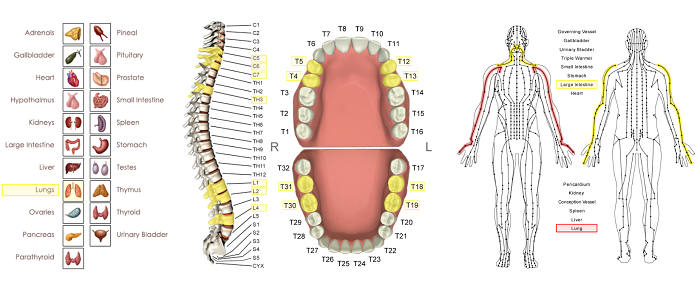
The lung meridian is energetically connected to the large intestine meridian. These meridians are closely related, as they both play a primary role in regulating the body’s water pathways.3
In addition to the large intestine and lung organs, the lung meridian also has an energetic connection to the following teeth and vertebrae:
- First and second pre-molars of the top teeth (T4, T5, T12, T13)
- First and second molars on the bottom teeth (T18, T19, T30, T31)
- Fifth, sixth, and seventh cervical vertebrae (C5, C6, C7)
- Third thoracic vertebrae (TH3)
- First, second, and fourth lumbar (L1, L2, L4)
Along with these physical connections, the lung meridian is strongly connected to the emotions of grief, sadness, shame, and anxiety. On the other hand, positive emotional attributes associated with the lung meridian include dignity, integrity, and high self-esteem.4
Due to these connections, the lung meridian both influences and is influenced by these physical and mental areas of wellness.
Symptoms of lung meridian imbalance
When the lung meridian experiences imbalances, it can manifest in various physical and mental symptoms. These imbalances may affect the immune system, respiratory system, and overall vitality.
More specifically, symptoms of a lung meridian imbalance may include:
- A weak cough
- Shortness of breath
- A weak voice
- Getting sick frequently
- Sensitivity to cold
- Dry skin
- Fever/chills
- Body aches
- Runny nose
- Grief and sadness4
How to balance the lung meridian
Keeping the lung meridian balanced is important for our overall health and wellness. Some of the best ways to restore and maintain the balance in this meridian include diet & lifestyle changes, herbal support, and acupuncture.
Diet & lifestyle

Lifestyle has a significant impact on the health of the lung meridian. Things like smoking, inactivity, and environmental pollution can upset the balance of this meridian. On the other hand, healthy activities like regular exercise and deep breathing can help to restore and maintain this balance. Activities like yoga, qigong, and tai chi can be especially helpful, as they incorporate deep breathing and movement together.
Diet and nutrition can also have an immense impact on lung meridian health. Foods that can cause phlegm to form such as dairy, fried foods, sugar, and flour may cause a deficiency.5
Along with avoiding these foods, it is believed that white-colored foods are beneficial for the lung meridian. Some of these include:
- Mushrooms
- Garlic
- Onions
- Cauliflower
- Rice
- Potatoes
- Pears
- Parsnips
- Almonds
- Chicken
- Tuna5
To increase qi in the lungs, consuming fresh foods that are slightly cooked is recommended.6
Herbal support
TCM recommends several herbs to support lung health. The following herbs can enhance immune function, support lung tissue, and aid in maintaining the proper flow of qi through the lung meridian:
- Astragalus
- Cordyceps
- Licorice root
- Ginseng root
- Mullein
- Marshmallow root6
It’s important to see a TCM practitioner for guidance before taking any of these herbs. A practitioner can provide tailored advice and treatment options, including acupuncture, herbs, and specific lifestyle adjustments.
Acupuncture/acupressure
An acupuncturist can do targeted needle placement for the lung meridian based on their assessment. They may also use acupressure as well, or you can try doing acupressure on your own.
Acupuncture points that are good for chest clearing include:
- Lung 6 – On the thumb-side of the inner forearm, about halfway up the wrist
- Kidney 27 – In the hollow area at the lower border of the collarbones
- Pericardium 6 – About 2 finger’s width above the inner wrist, in the center between the two tendons.
To stimulate these points using acupressure, press on them firmly for 5 deep breaths.7
Lung Meridian stressor Virtual Item
A digital representation of the lung meridian is automatically scanned in the Balance software, as well as in the Link app. It can also be scanned with the Select and Elite software. The reports will show whether this Virtual Item is out of range, along any other out-of-range biomarkers.
Lung Meridian balancer Virtual Items
If out of range, you can see which balancers bring the Lung Meridian Virtual Item back into range in the reports, whether that’s in the biomarker progress chart in the software, or by clicking on a specific product in the Link app and scrolling down to the Biomarkers section.
 About Seth Morris
Seth Morris is an experienced article writer with a background in marketing, Web content creation, and health research. In addition to writing and editing content for the ZYTO website and blog, he has written hundreds of articles for various websites on topics such as holistic wellness, health technology, and Internet marketing. Seth has earned Bachelor’s Degrees in Business Management as well as Literary Studies.
Sources:
1. “Lung: Metal-energy yin organ.” Lieske. Lieske.com.
2. “The Lung Meridian.” Simply better living. meine-tcm.com.
3. “Grief, Sorrow, Letting Go & Lung Meridian Imbalance | Five Element Series.” Tula Somatics LLC. Tulasomatics.com.
4. “How Emotions and Organs Are Connected in Traditional Chinese Medicine.” Verywell Mind. Verywellmind.com.
5. “Easy Ways to Nourish Lung Qi.” ActiveHerb Technology, Inc. Activeherb.com.
6. Saper, James. “Diet Guidelines for Lung Qi Deficiency.” Eastmountain.ca.
7. “Exploring Traditional Chinese Medicine for Lung Repair: A Blend of Ancient Wisdom and Modern Science.” Eastern Acupuncture and Wellness. Eacuwell.com.