Being an acupuncturist requires a tremendous amount of education and experience. But this type of practitioner can only be effective if they have the right tools as well. This of course includes the basics: acupuncture needles, guide tubes, etc. However, there are a host of other tools that acupuncturists use to improve client care even further. The following are the top 10 acupuncture tools used to provide not only an improved experience for patients, but better results as well.
Massage table or chair
Being poked with needles isn’t the most pleasant experience. But treatments can be made more bearable by providing a comfortable table or chair. Massage tables are typically used for acupuncture treatment as well. Some of these tables are pretty basic, while others offer features like comfortable padding and the ability to adjust the table automatically.
To enhance comfort even further, some acupuncturists provide high-end reclining chairs for their clients. Pillows are another important component that help clients relax even more during their treatments.
Heat therapy and moxibustion
Heat therapy is commonly used in conjunction with acupuncture to provide better results. This involves using an infrared lamp to warm up the area of skin being treated. Infrared heat penetrates deep into the skin, improving circulation and decreasing discomfort involved with acupuncture needles.
Similarly, moxibustion may be used to warm up the skin and improve circulation. This involves burning a medicinal herb called moxa next to the area of skin being treated. Moxibustion and heat therapy can also be used by anyone in the comfort of their own home.
Auriculotherapy device

Another common acupuncture tool, an auriculotherapy device is used to stimulate acupuncture points on the inner ear. The device uses an electrical wand to both detect and treat these points on the ear. Auriculotherapy is a painless alternative to ear acupuncture that can help with arthritis, chronic pain, and gastrointestinal issues. It can also be effective for treating addictions such as smoking.1
Acu-magnets
A treatment known as magnetic field therapy can also be used alongside traditional acupuncture treatment, or as an alternative for those who have are unable to be treated with needles. Known as acu-magnets, these specialized magnets are applied to specific acupuncture points to stimulate the body’s flow of energy. Acu-magnets may also be prescribed for home use to complement in-office treatments.
Essential oils and herbs
More and more acupuncturists are combining essential oils with their treatments to improve results. Diffusing essential oils can create an atmosphere that’s more conducive to healing, and applying them topically can have a similar positive effect. Oils that are calming to the shen, or spirit, are often used during acupuncture treatments. These include:
- German chamomile
- Frankincense
- Lavender
- Mandarin
- Rose
- Sandalwood
- Violet
- Ylang Ylang2
While essential oils are a relative newcomer, Chinese herbs have been used with acupuncture for hundreds of years. Combined with acupuncture, herbs can alleviate a variety of conditions including pain and depression.3
ZYTO technology

The ability to assess a client’s state of health and wellness is essential to providing effective treatments. ZYTO offers a powerful tool that assists many acupuncturists in this area of wellness assessment. Our technology measures the body’s galvanic skin response to determine which products, services, and other wellness options the body responded to most strongly. Using biologically preferable products and services helps the body shift to a more balanced energetic state.
Along with scanning for items that can help balance the body, ZYTO also provides detailed information about the various body systems, parts, and environmental factor Virtual Items that are scanned. This includes traditional Chinese medicine (TCM) meridians. In our more advanced systems, digital signatures representing Mu Shu points and TMJ acupuncture points on the body can also be scanned.
Electroacupuncture device
Electroacupuncture involves passing an electric current through the inserted needles to further stimulate acupuncture points. The current is created with an electroacupuncture device fitted with small clips to transmit the electric pulses. The intensity and frequency of the electric pulse can also be varied depending on the condition being treated.
Studies show electroacupuncture to be effective in treating a variety of conditions, including fibromyalgia, obesity, and depression.4 5 6 However, those who have a history of heart problems, seizures, or epilepsy should avoid this type of acupuncture treatment.7
Gua sha
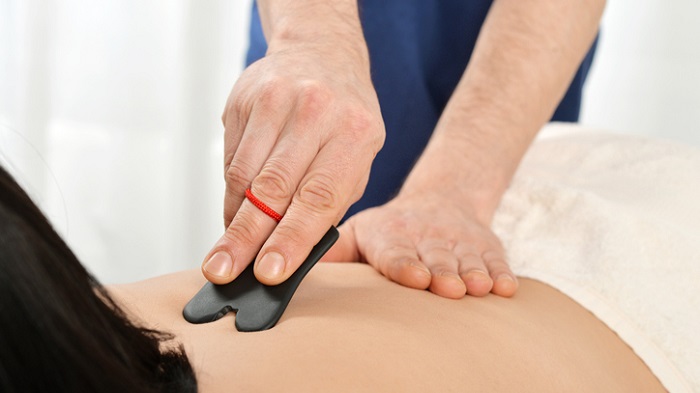
Often used as either an alternative or complementary treatment to acupuncture, gua shua involves using a hard tool to scrape the skin. Applying pressure to the skin in this manner is said to relieve pain. And in fact, research has shown gua sha to be an effective treatment for ailments such as neck pain and premenopausal syndrome.8 9
While gua sha may be a good alternative for those who are afraid of needles, the process does involve applying enough pressure to cause some bruising. There is also a small risk that the treatment could break the skin, resulting in bleeding.
Laser therapy
Laser therapy is yet another tool that acupuncturists can use on needle-phobic patients. This treatment utilizes a cold laser to stimulate acupuncture points. Though high-powered lasers are available, most have a low power output and are classified as Class IIIA devices by the FDA.
Research shows that laser acupuncture is a viable alternative to needle acupuncture for a variety of health problems, including chronic tension headaches, myofascial pain, postoperative nausea, and osteoarthritis.10 Practitioners and patients should know that these devices should never be used near the eyes, and the beam shouldn’t be stared at either directly or on the skin.11
Cupping
Cupping is another tool that many acupuncturists have added to their practice. This treatment involves placing cups on the skin for several minutes to create suction, which pulls the skin upward. Cupping is used to treat a variety of conditions, including:
- Muscle, joint, and bone pain
- Carpal tunnel syndrome
- Plantar fasciitis
- Fibromyalgia
- Respiratory issues12
Like many of the acupuncture tools on this list, cupping sets are also available for the general public to buy and use in the comfort of their own homes. However, an experienced acupuncturist typically provides better results compared to in-home treatments.
 About Dr. Vaughn Cook
Dr. Vaughn R Cook is the Founder & CEO of ZYTO. An Oriental Medical Doctor (OMD) and licensed acupuncturist, he has worked in the complementary and alternative medical field for more than 30 years, specializing in applications that integrate Western and Eastern medicine.
Sources:
1. de Marchi, C., & D. Concina. “Auriculotherapy for Smoking Cessation: An Observational Study of Outcomes.” Medical Acupuncture 26, no. 3 (2014): 180-188.
2. Daley, Alice. “Enhance Your Acupuncture Practice with the use of Essential Oils.” AOMA Academy, LP. Aoma.edu.
3. “Acupuncture Plus Herbs Alleviate Depression.” Healthcare Medicine Institute. Healthcmi.com.
4. Deluze, C., L. Bosia, et al. “Electroacupuncture in fibromyalgia: results of a controlled trial.” British Medical Journal 305 (1992): 1249.
5. “Cabioglu, M.T., & N. Ergene. “Electroacupuncture Therapy for Weight Loss Reduces Serum Total Cholesterol, Triglycerides, and LDL Cholesterol Levels in Obese Women.” The American Journal of Chinese Medicine 33, no. 4 (2005): 525-533.
6. “Han, C. L. X, et al. “Clinical study on electro-acupuncture treatment for 30 cases of mental depression.” Journal of Traditional Chinese Medicine 24, no. 3 (2004): 172-176.
7. “Electroacupuncture.” Acupuncture Today. Acupuncturetoday.com.
8. “Neck Pain: Possible Causes and How to Treat It.” Healthline Media. Healthline.com.
9. Meng, F., P. Duan, et al. “Effect of Gua sha therapy on perimenopausal syndrome.” The North American Menopause Society 24, no. 3 (2017): 299-307.
10. Rashoud, A.S., R.J. Abboud, et al. “Efficacy of low-level laser therapy applied at acupuncture points in knee osteoarthritis: a randomised double-blind comparitive trial.” Physiotherapy 100, no. 3 (2014): 242-248.
11. Thompson, Kimberly. “Laser Acupuncture in Your Practice: What you Need to Know.” Acupuncture Today. Acupuncturetoday.com.
12. “What Is Cupping?” American Institute of Alternative Medicine. Aiam.edu.